
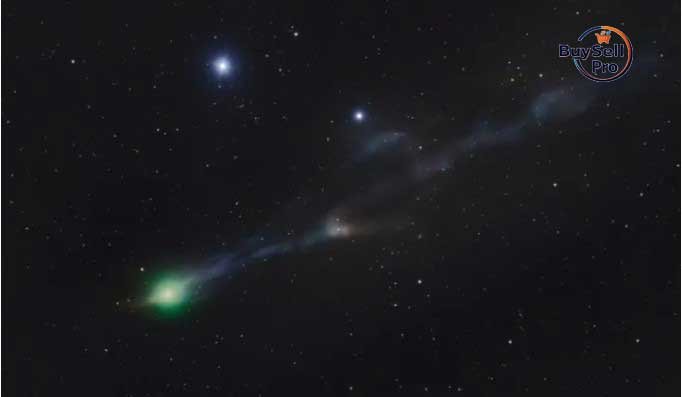

The universe continues to surprise us with celestial visitors. Recently, the interstellar comet 3I Atlas has captured global attention. This cosmic traveler brings fresh insights into our solar system’s mysteries. Scientists worldwide are studying this remarkable object with unprecedented detail.
What Makes 3I Atlas Comet Special?
The 3I Atlas comet stands out among celestial objects. It originated from beyond our solar system. This makes it only the third confirmed interstellar visitor. Moreover, its journey offers unique opportunities for scientific research. Astronomers can study materials from distant star systems.
Furthermore, this comet’s composition differs from typical solar system comets. Scientists have detected unusual chemical signatures. These findings challenge our understanding of comet formation. Additionally, the comet’s trajectory provides clues about its origin.
NASA’s Four Key Revelations About Interstellar Comet 3I Atlas
NASA recently shared groundbreaking discoveries about the 3I Atlas comet. First, the comet exhibits non-gravitational acceleration. This phenomenon puzzles researchers worldwide. The acceleration suggests active outgassing from the comet’s surface.
Second, NASA detected complex organic molecules in its tail. These molecules indicate rich chemistry in distant star systems. Third, the comet’s nucleus appears larger than initially estimated. Current measurements suggest a diameter exceeding two kilometers.
Finally, scientists observed unusual dust patterns around the comet. These patterns reveal information about solar wind interactions. Consequently, researchers are revising their models of interstellar objects.
Mars Spacecraft Captures Stunning Images of 3I Atlas
NASA’s Mars orbiters have photographed the interstellar comet 3I Atlas. These images provide unprecedented views of the cosmic visitor. The spacecraft captured detailed shots of the comet’s coma and tail.
Interestingly, the Mars perspective offers unique advantages. The red planet’s position enabled observations impossible from Earth. Scientists can now study the comet from multiple angles. This multi-point observation enhances our understanding significantly.
Additionally, the images reveal intricate structures within the comet’s tail. These structures suggest complex gas and dust dynamics. Researchers are analyzing these patterns to understand outgassing mechanisms.
Understanding the Composition of 3I Atlas Comet
The 3I Atlas comet’s composition fascinates astronomers worldwide. Spectroscopic analysis reveals water ice and carbon dioxide. However, the ratios differ from solar system comets. This suggests formation in a different stellar environment.
Moreover, scientists detected trace amounts of ammonia and methane. These compounds provide clues about temperature conditions during formation. The comet also contains silicate dust particles. These particles resemble those found in protoplanetary disks.
Furthermore, organic compounds detected include formaldehyde and methanol. These molecules are building blocks for complex chemistry. Their presence indicates rich chemical processes in the comet’s birthplace. You can explore more about space discoveries and cosmic phenomena through various scientific resources.
The Trajectory and Origin of Interstellar Comet 3I Atlas
Tracking the 3I Atlas comet’s path reveals its interstellar origins. The comet entered our solar system at high velocity. Its hyperbolic trajectory confirms it won’t return. Scientists have traced its path backward through space.
Calculations suggest the comet originated from a distant star system. The exact source remains uncertain. However, researchers narrow down potential candidates. The comet likely traveled for millions of years before reaching us.
Additionally, its trajectory provides insights into galactic dynamics. The path reveals information about gravitational influences during its journey. This data helps scientists understand interstellar space better.
Non-Gravitational Acceleration Mysteries
The non-gravitational acceleration of 3I Atlas puzzles researchers. This acceleration exceeds predictions based on outgassing alone. Several theories attempt to explain this phenomenon. Some scientists propose asymmetric outgassing from the nucleus.
Others suggest the comet’s rotation influences the acceleration. The spinning motion could create uneven thrust. Additionally, subsurface ice sublimation might contribute. This process could generate unexpected forces.
Furthermore, the acceleration pattern changes over time. These variations complicate theoretical models. Researchers continue monitoring the comet closely. New observations may resolve this mystery soon.
Scientific Significance of Studying 3I Atlas
Studying the interstellar comet 3I Atlas advances multiple scientific fields. First, it provides samples from another star system. This offers unprecedented research opportunities. Scientists can compare interstellar and solar system materials directly.
Second, the comet helps us understand planet formation elsewhere. Its composition reveals conditions in distant protoplanetary disks. Third, studying its trajectory improves our knowledge of galactic dynamics.
Moreover, the comet’s behavior tests our theoretical models. Discrepancies between predictions and observations drive scientific progress. Additionally, this research prepares us for future interstellar visitors. According to Space.com’s detailed coverage, scientists expect more such discoveries in coming years.
Future Observations and Research Directions
The scientific community plans extensive future observations of 3I Atlas. Multiple telescopes worldwide coordinate their efforts. Space-based observatories provide continuous monitoring. Ground-based facilities contribute complementary data.
Researchers will track the comet until it leaves our solar system. This long-term monitoring reveals evolutionary changes. Scientists hope to observe the comet’s behavior at different solar distances.
Furthermore, advanced spectroscopic studies are planned. These will identify additional chemical compounds. High-resolution imaging will reveal surface features. All these efforts contribute to our cosmic understanding.
The Legacy of Interstellar Comet 3I Atlas News
The interstellar comet 3I Atlas represents a milestone in astronomy. Its discovery and study advance our cosmic knowledge significantly. Scientists have learned about distant star systems through this visitor.
Moreover, the comet challenges existing theories and models. This drives innovation in astronomical research. The 3I Atlas comet reminds us of our universe’s vastness. It demonstrates that cosmic surprises await discovery.
Finally, this celestial visitor inspires future generations of astronomers. The ongoing research will yield insights for years to come. The interstellar comet 3I Atlas truly marks a new chapter in space exploration.
